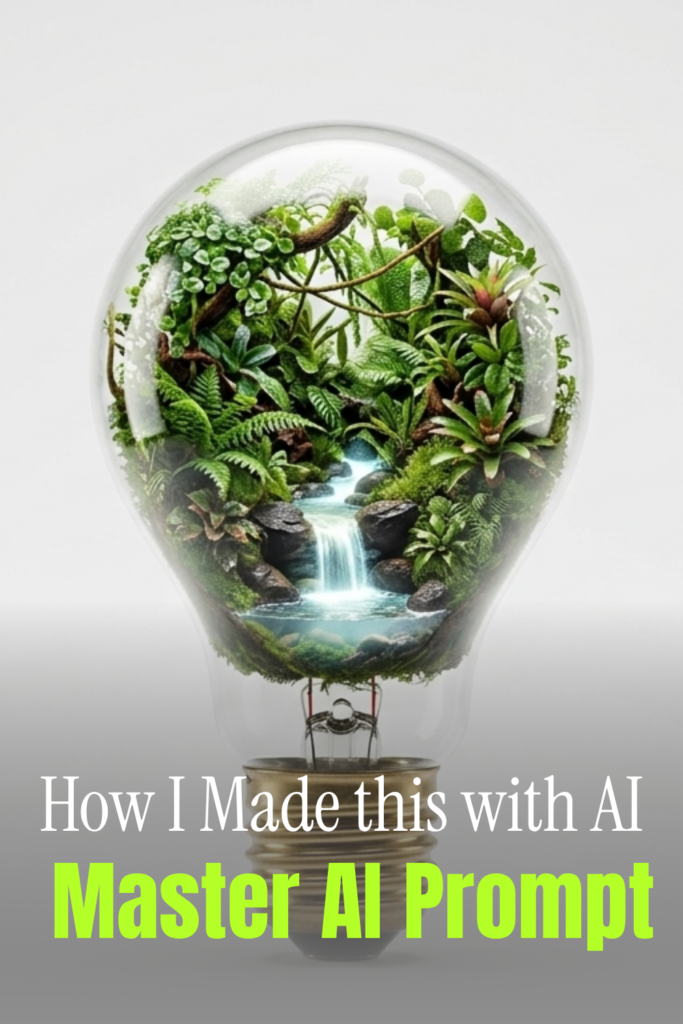
Hello, creative minds and lovers of miniature marvels! Today, I’m taking you behind the curtain to reveal the making of my recent favorite project: the “Enchanted Rainforest Lightbulb.”
When I first envisioned this piece, I wanted to capture something impossible. A lightbulb is a symbol of an idea, a burst of invention. I wanted to turn that on its head and fill that vessel with something ancient, organic, and full of life—a miniature rainforest.
The process of bringing this conceptual idea to life was a fascinating exercise in digital craftsmanship. Here’s how I structured the workflow and the prompts to achieve this hyper-detailed result.
The Vision: A World in a Drop
The core of the project was the contrast. The clean, sharp geometry of modern technology (the lightbulb) meeting the wild, dense complexity of a thriving jungle. I didn’t want it to just look like a drawing; it needed the realism of a high-end commercial photo shoot.
To achieve this, I broke the visualization down into four key components:
1. The Container (The Vessel)
The foundation of the image had to be the lightbulb itself.
- Prompt Language Used: “A transparent glass lightbulb,” “sharp edges,” “professional product photography style.”
I focused on the physical properties. This wasn’t just a bulb; it was a high-end product. I needed the glass to look flawless and the brass screw base to have texture and a subtle, realistic patina. Specifying “sharp edges” and a “product photography style” was crucial to tell the machine that the object itself needed the polished, high-end look of a real item ready for sale.
2. The Internal Flora (The Ecosystem)
This is where the magic (and the complexity) lies. Fitting a whole rainforest into a bulb isn’t easy. I needed density.
- Prompt Language Used: “miniature lush rainforest,” “hyper-detailed foliage.”
Rather than just listing types of plants (which can confuse an AI at this scale), I focused on descriptors that imply abundance. “Hyper-detailed foliage” was essential. It commanded the generator to push the pixel density to its limit, ensuring that even when you zoom in on the ferns and bromeliads, they retain their structure. I needed it to feel compact but not claustrophobic.
3. The Focal Point (The Water)
A rainforest without water isn’t a rainforest. But just having water isn’t enough; it needs a story.
- Prompt Language Used: “a tiny glowing waterfall inside.”
The word “glowing” is the pivot here. Without it, the waterfall would just be dark, wet rocks. The “glow” transforms it into a mystical source of energy, perfectly interacting with the glass. It casts reflections and adds a central narrative: Is this waterfall the power source for the bulb?
4. The Atmosphere (The Light and Canvas)
This component unites all the elements. To make a tiny object feel massive internally, you need specialized lighting.
- Prompt Language Used: “soft volumetric lighting,” “white minimalist background,” “4k.”
This is the key. Traditional studio lighting is often flat. But “volumetric lighting” implies the presence of mist and particles, allowing the light to “have volume” as it interacts with the foliage and the glass. This makes the tiny interior feel vast. The background had to be “minimalist white” to ensure nothing distracted from the centerpiece, isolating the object in space.
The Technical Execution and Refinement
Once I had this structured prompt, the real work began. The initial generations were close, but required refinement. I ran several iterations to get the plant species just right and to ensure the waterfall’s placement was architecturally sound within the bulb’s base. I used a variation technique to explore slightly different balances of light and shadow, finally settling on the version you see here for its perfect clarity and atmospheric depth.
Creating this piece wasn’t just about keywords; it was about imagining a complete scene, from the humidity inside the glass to the cleanliness of the studio desk it rests upon.