
Introduction
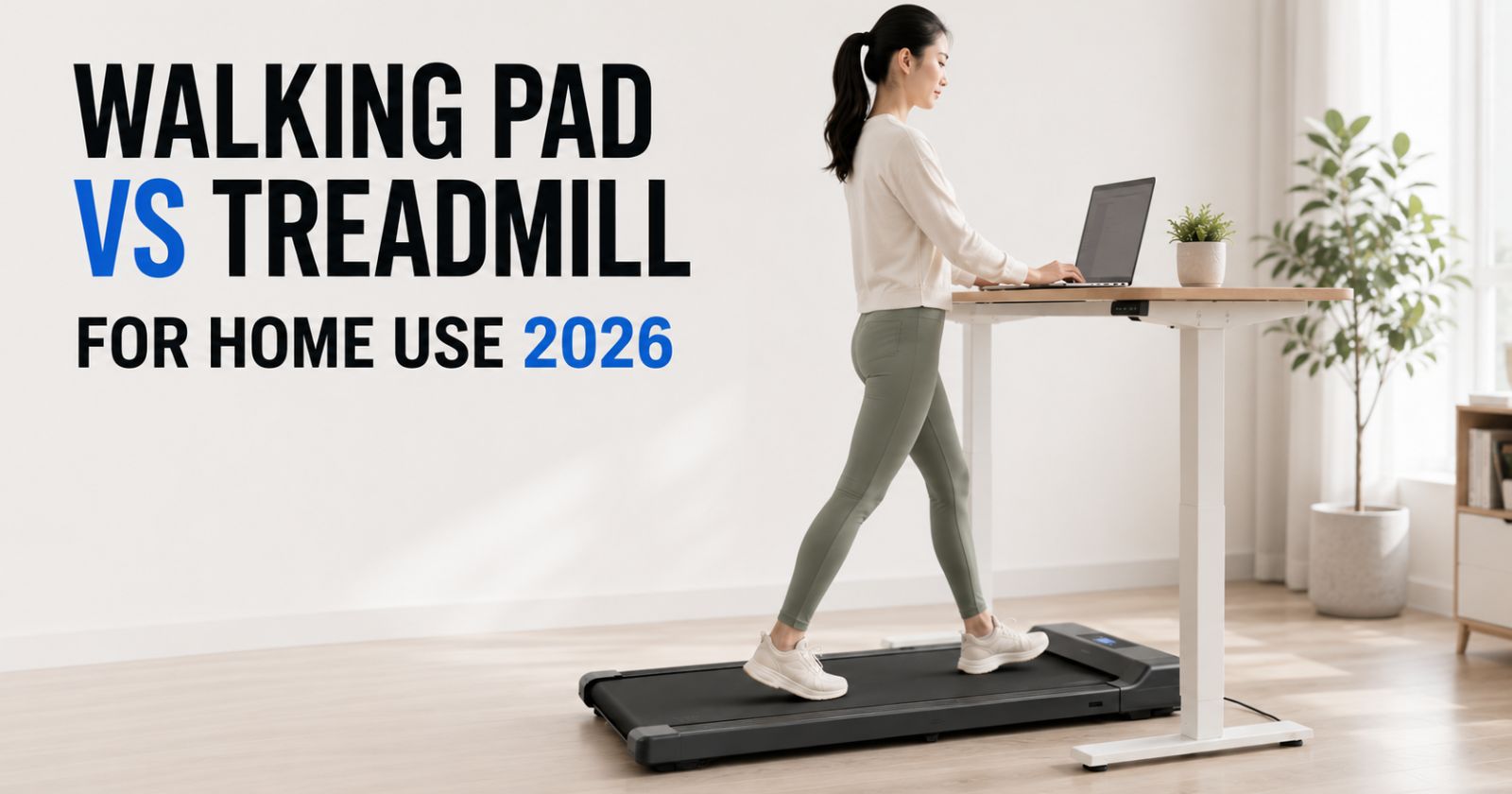
Walking Pad vs Treadmill: these are two completely different tools built for two completely different types of people. Picking the wrong one doesn’t just waste money — it means the machine ends up as an expensive coat rack within three weeks.
This guide cuts through the marketing fluff. You’ll get a head-to-head comparison on price, space, noise, health benefits, and real-world usability — plus a clear answer on which one actually fits your life in 2026.
1. The Real Difference Between a Walking Pad and a Treadmill
Before we compare them, let’s be clear on what each one actually is.
A walking pad (also called an under-desk treadmill) is a compact, flat motorized belt designed specifically for walking at slow speeds — typically between 0.5 and 4 mph. Most models have no handrails, no large console, and a low profile that lets them slide under a standing desk or a sofa when not in use.
A traditional treadmill is a full-sized motorized machine built for walking, jogging, and running — usually up to 10 or 12 mph. It comes with handrails, an upright console, multiple workout programs, incline settings, and a much longer belt to accommodate a running stride.
A walking pad is a compact, motorized belt designed purely for walking, usually without handrails, perfect for sliding under standing desks. Traditional treadmills are larger, more powerful machines with safety rails and consoles, built for walking, jogging, and running up to 12 mph with adjustable inclines. Surfer
The bottom line? A walking pad is not a cheaper, worse version of a treadmill. It’s a purpose-built tool for a completely different use case — and that distinction matters a lot when you’re spending your money.
2. Walking Pad vs Treadmill: Side-by-Side Comparison
| Feature | Walking Pad | Traditional Treadmill |
|---|---|---|
| Speed range | 0.5 – 4 mph (walking only) | 0.5 – 12 mph (walk + run) |
| Motor power | 1.5 – 3.0 CHP | 2.5 – 4.0 CHP |
| Average price (2026) | $130 – $500 | $500 – $2,000+ |
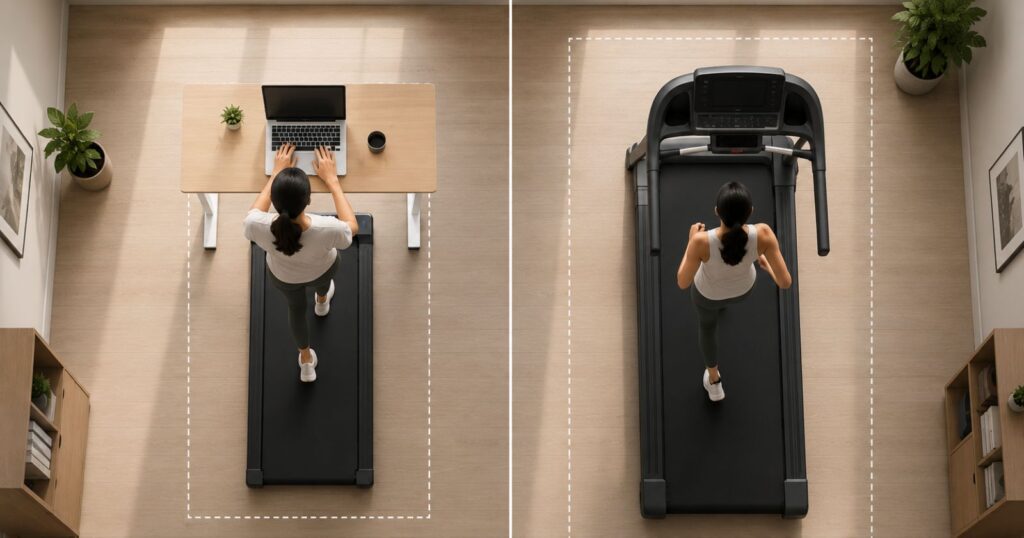
| Footprint | ~48″ × 20″ (slides under desk) | ~70″ × 32″ (permanent spot) |
| Weight | 40 – 65 lbs | 150 – 300 lbs |
| Incline | Rare (some newer models) | Standard (5–15%) |
| Handrails | None on most models | Yes |
| Noise level | 40 – 50 dB (whisper quiet) | 60 – 75 dB |
| Best for | WFH, light daily movement | Runners, serious training |
| Storage | Folds/slides under desk or sofa | Needs dedicated space |
| Assembly | Minimal (15–30 min) | Complex (1–2 hrs) |
| Warranty (typical) | 1 year | 2–5 years |
3. Who Should Buy a Walking Pad?
Walking pads are not for everyone. But for the right person, they are one of the smartest purchases you can make in 2026.
You’re the right candidate if you check most of these boxes:
- You work from home and spend 5+ hours a day sitting at a desk
- You live in an apartment or have limited floor space
- Your goal is movement, not performance — you want more steps, not faster miles
- You’re a beginner who hasn’t exercised consistently in a while
- You want something quiet enough to use on calls without anyone noticing
- Your budget is under $400 and you want quality without overpaying
Walking at a treadmill desk burns 105 extra calories per hour, improves memory and attention, and reduces joint pain from prolonged sitting. The ROI is strongest for people who spend 4+ hours daily on tasks like emails, calls, and meetings. Digital Toppers
Think of a walking pad this way: it doesn’t replace the gym. It replaces sitting.
If you’re the kind of person who always says “I’ll go for a walk later” and then never does, a walking pad removes all the friction. It’s already there, already set up, and ready to go while you answer emails at 9 a.m.
Pro Tip: The biggest predictor of whether a walking pad collects dust is your desk setup. If you have a standing desk or a desk you can raise, you’ll use the walking pad every single day. If you don’t, consider whether it’s worth pairing the two purchases together.
4. Who Should Buy a Treadmill?
A traditional treadmill is the right choice if your goals go beyond daily steps. It makes sense when:
- You want to run — walking pads simply cannot safely support running speeds
- You’re training for something — a 5K, a half marathon, or structured cardio intervals
- You have the space — a dedicated room or garage where it can live permanently
- Your budget is $600+ — this is where quality treadmills actually start
- You want incline training — steeper inclines dramatically increase calorie burn and are unavailable on most walking pads
- Multiple people will use it — treadmills handle heavier daily use from different users better
One important note: if you already belong to a gym and go regularly, a treadmill at home is probably redundant. You’re likely better off with a walking pad for the in-between days when you don’t make it in.
5. Health Benefits — What the Research Actually Says
Here’s where walking pads consistently surprise people. The health case for low-speed, sustained walking is actually stronger than most people realize.
What science says about sitting less
The average adult sits for more than 10 hours a day, and prolonged sitting has been linked to increased risks of heart disease, certain cancers, and even a shorter lifespan — regardless of how much you exercise otherwise. Fraud Blocker™
That last part is the kicker. You can work out for an hour every evening and still face elevated health risks if you sit for nine hours during the day. A walking pad directly addresses the sitting problem in a way that a gym session doesn’t.
What a 2021 study found
A 2021 study showed that office workers who used walking pads walked an average of 4,500 more steps a day. That’s roughly two additional miles per day — without changing anything else about their routine. Fhseohub
The Mayo Clinic’s take
According to a Mayo Clinic study, using an active workstation such as a walking pad can enable workers to remain productive and mentally sharp while also aiding in the prevention and treatment of conditions like obesity, cardiovascular disease, and diabetes. Lienseo
Does a treadmill offer more benefits?
In terms of cardiovascular fitness and calorie burn per session, yes — a treadmill wins if you’re actually running on it. But that’s the problem. Most people don’t run consistently. A walking pad you use for 90 minutes a day, five days a week, delivers far more real-world health value than a treadmill that gets used twice a week and then avoided.
Consistency beats intensity for long-term health outcomes. Walking pads make consistency easy.
6. Price Breakdown: What You Actually Pay in 2026
Let’s talk real numbers — not the aspirational prices on manufacturer websites.
Walking pad price tiers
- Budget ($90 – $200): Entry-level models with basic LED displays, motors under 2.0 CHP, and 1-year warranties. Fine for occasional light use. Consumer Reports evaluated models ranging in price from $150 to $1,400 and found serious safety concerns with some lower-end walking pads, including narrow belts and poor build quality. Proceed carefully in this range. infobrave
- Mid-range ($200 – $400): The sweet spot in 2026. Models like the WellFit TM037 sit in this range and offer 3.0 CHP brushless motors, quiet operation under 45 decibels, and folding designs. At a price point that frequently dips below $189 during sales, the TM037’s value-to-performance ratio is nearly unbeatable. infobrave
- Premium ($400 – $800): Wider belts, incline options, app connectivity, and longer warranties. Worth it if you plan to use it for 2+ hours daily.
Treadmill price tiers
- Budget ($300 – $600): Basic motorized treadmills with limited speed range and flimsy frames. Not recommended for regular runners.
- Mid-range ($600 – $1,200): Decent quality, 2.5–3.5 CHP motors, basic incline. Good for casual joggers.
- Premium ($1,200 – $2,500+): Brands like NordicTrack, Peloton Tread, and Sole. Suitable for serious training with multi-year warranties.
Hidden costs to factor in
- Walking pad + standing desk combo: add $200 – $500 for a motorized desk
- Treadmill delivery and assembly: often $100 – $200 extra
- Extended warranty for either: $50 – $150/year
- Treadmill maintenance (belt lubrication, repairs): $50 – $200/year
7. Space Requirements: The Real Numbers
Space is where the walking pad vs treadmill debate gets decided for most people — especially in apartments and smaller homes.
Walking pad footprint
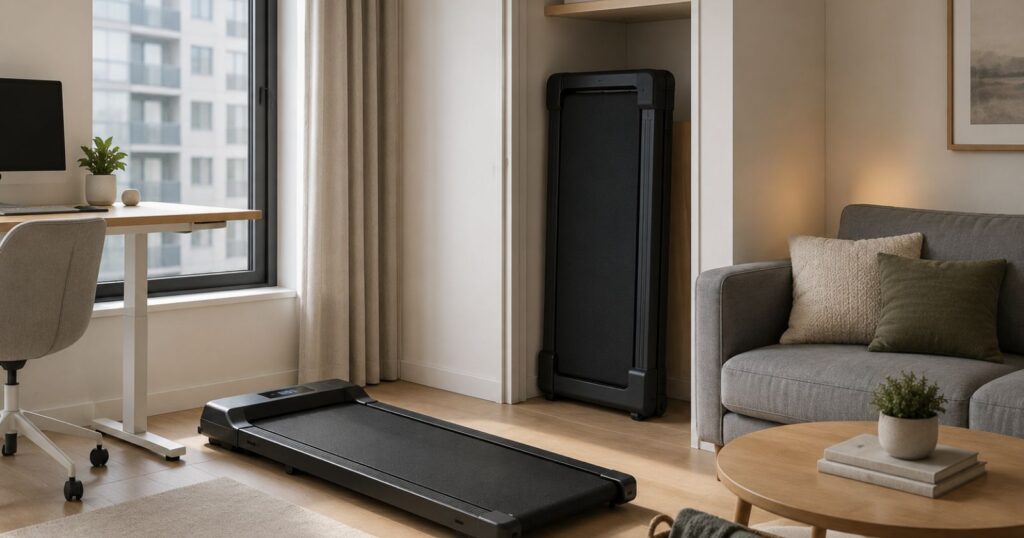
A typical walking pad measures around 48 inches long × 20 inches wide when in use. When folded or stored upright, many models fit in a closet or slide flat under a queen-size bed or sofa. Weight runs between 40 and 65 pounds, which means most people can move them alone.
Treadmill footprint
A standard treadmill measures around 70 inches long × 32 inches wide — and it needs additional clearance behind it (at least 8 feet of total runway length is recommended for safety when running). Weight ranges from 150 to 300 pounds, meaning once it’s in a room, it rarely moves.
| Walking Pad | Treadmill | |
|---|---|---|
| Floor space in use | ~6.5 sq ft | ~15.5 sq ft |
| Total space needed (safety clearance) | ~10 sq ft | ~35 sq ft |
| Storage when not in use | Under desk, sofa, or closet | Stays where it is |
| Moveable by one person? | Yes | No |
If you’re in a studio apartment, the choice is straightforward. Even in a two-bedroom home without a dedicated gym room, a treadmill feels imposing fast. Walking pads disappear when you’re done.
8. The Noise Factor (More Important Than You Think)
This is the detail most comparison articles skip — and it genuinely matters.
Walking pads operate at 40 to 50 decibels, roughly the noise level of a quiet conversation or a library. You can walk on one during a Zoom call and your coworkers won’t know. You can use it while your partner watches TV in the same room. You can run it at 6 a.m. in an apartment without disturbing a neighbor downstairs.
Traditional treadmills run at 60 to 75 decibels — comparable to a vacuum cleaner or a busy restaurant. They vibrate. They hum. In an apartment building, that can be a genuine problem for neighbors below you, especially during peak hours.
If you work from home and want to walk during meetings, noise isn’t optional — it’s the whole point. Walking pads win here decisively.
9. Five Things Nobody Tells You Before You Buy
These are the things that only show up in owner reviews six months after purchase.
1. Walking pads aren’t great for tall people. Most walking pad belts are 14 to 19 inches wide and under 50 inches long. If you’re over 6’2″ with a long stride, the belt will feel cramped, even at walking speeds. Try before you buy if possible, or choose a model with at least a 47-inch belt length.
2. You need a standing desk to use a walking pad properly. Most people don’t realize this until after they buy. A walking pad at desk height requires you to stand at your computer, not sit. Without a standing desk, the walking pad becomes a floor-level walking machine — not useless, but not what most buyers had in mind.
3. The cheapest walking pads have a “stuttering” problem. Budget competitors that use anemic 1.5 CHP motors often cause a “stuttering” effect that plagues walkers during a slow-paced Zoom call. A motor under 2.0 CHP struggles to maintain consistent belt speed at very low settings. Spend a little more and get at least a 2.5 CHP brushless motor. Outrank’s Blog
4. Treadmill warranties matter a lot more than people think. Most walking pads come with a warranty for one year or less, often with exclusions, and Amazon reviews indicate customer service is often unhelpful. If something breaks on a $200 machine, you’re often just buying another one. Factor this in when comparing “cheap” options. Link Assistant
5. You’ll walk more than you expect. Almost every walking pad owner says the same thing: they were skeptical, and then they started using it during emails, calls, and streaming — and suddenly they were hitting 8,000 to 10,000 steps before lunch. The lower the friction, the more you actually move.
10. The Verdict: Which One Should You Choose?
Let’s make this simple.
Choose a walking pad if:
- You work from home or spend most of your day at a desk
- You live in an apartment, small home, or don’t have a dedicated gym space
- Your goal is daily movement and better health habits — not athletic performance
- Your budget is under $500
- You care about noise levels
Choose a treadmill if:
- You plan to run or do serious cardio training at home
- You have a dedicated room or garage for it
- You’re training for a race or specific fitness goal
- Your budget is $600 or more
- Multiple people in your household will use it regularly
The honest truth? For the majority of work-from-home Americans in 2026, a walking pad in the $200–$400 range is the smarter buy. Most people who buy treadmills use them three times and then feel guilty about the space they take up. A walking pad that you use for 90 minutes every workday is infinitely more valuable.
The best fitness equipment is the one you actually use.
For more practical guides on home health, tech, and everyday life, browse InfoBrave’s Informative section. And if you want to pair your walking pad with better daily habits, check out InfoBrave for lifestyle tips that actually stick.
You Might Also Like on InfoBrave
How to Make Dandelion Tea From Scratch – The Complete 2026 Guide
11. Frequently Asked Questions
Can I run on a walking pad?
No — and you shouldn’t try. Most walking pads are capped at 4 mph and have no handrails. The belts are shorter and narrower than a running stride requires, and the motors aren’t built for the sustained load of jogging or running. If you want to run, you need a traditional treadmill with a 2.5 CHP+ motor, a longer belt, and handrails for safety.
Are walking pads actually effective for weight loss?
Yes, with realistic expectations. Walking at a treadmill desk burns approximately 105 extra calories per hour, which adds up significantly over a week. Walking for two hours a day at a slow pace can burn 200 or more calories compared to sitting. Combined with a sensible diet, consistent walking pad use can absolutely support weight loss over time — but it’s a slow burn, not a quick fix. Digital Toppers
What’s a good budget for a walking pad in 2026?
The sweet spot is $200 to $400 for a reliable model with a brushless motor, quiet operation, and decent warranty. Under $150 you start running into build quality issues. Over $500, you’re paying for premium features (incline, wider belt, app integration) that most casual users don’t need.
Do walking pads work without a standing desk?
Technically yes — you can use one on the floor in front of a TV or while watching your phone. But the main use case (walking while working) requires standing at a desk. If you don’t have one, a motorized standing desk starts around $250 and makes the combination far more practical.
How loud is a walking pad? Can I use it on Zoom calls?
Most quality walking pads run at 40 to 50 decibels — quieter than a typical conversation. Your microphone will not pick up the belt sound unless you’re using a very sensitive open-back mic at low volume. The vast majority of users report using them during calls without any issues.
How much space does a walking pad need?
In use, a typical walking pad takes up about 48″ × 20″ of floor space. When folded or stored, many models slide under a bed, sofa, or stand upright in a closet. Compare that to a traditional treadmill which needs roughly 70″ × 32″ plus safety clearance — a walking pad takes up a fraction of the space.
Is a walking pad worth it if I already have a gym membership?
Yes, for different reasons. A gym handles your workout sessions. A walking pad handles the other 10 hours of the day when you’re sitting at a desk. They solve different problems. Many people with gym memberships find a walking pad one of the best purchases they’ve made because it adds movement to the hours where they’d otherwise be completely sedentary.