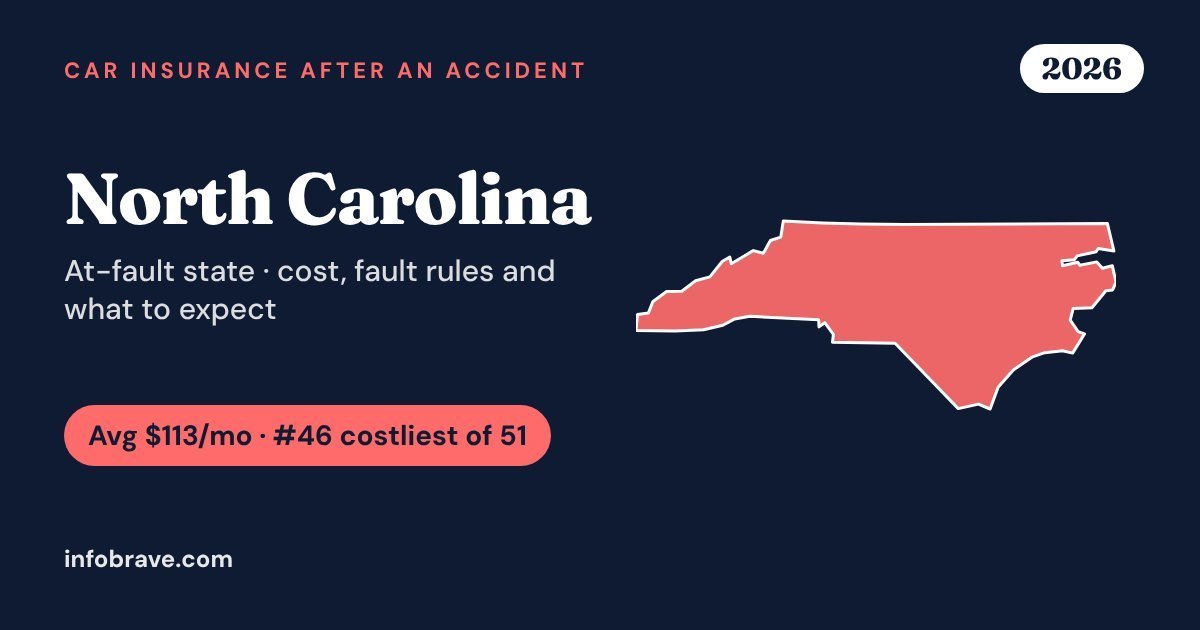

Quick answer: Car insurance after an accident in North Carolina usually raises your premium, and in North Carolina the starting point is already well below the national figure. The average full-coverage premium in North Carolina is about $113 a month ($1,356 a year) for a clean-record driver, 40% below the national average of $187 (Insurify, September 2026). That makes North Carolina the #46 most expensive of 51 jurisdictions. North Carolina is an at-fault state, so the driver who caused the crash pays through their liability insurance. After an at-fault crash, national data suggests rates rise by about 34%, which would mean roughly $1,817 a year here.
Table of contents
Table of Contents
ToggleNorth Carolina Accident and Insurance Facts at a Glance
| Item | North Carolina |
|---|---|
| Fault system | At-fault |
| Minimum bodily injury liability (per person / per accident) | $50,000 / $100,000 |
| Minimum property damage liability | $50,000 |
| Other required or standard coverage | UM/UIM $50,000 / $100,000 |
| Average full coverage, clean record | $113/month ($1,356/year) |
| Rank for highest average premium (of 51) | #46 |
| Typical rate impact of a not-at-fault accident (national) | about +22% |
| Typical rate impact of an at-fault accident (national) | about +34% |
Rates are averages for drivers aged 20 to 70 with a clean record and average or better credit, and will differ from your quote. Minimums are state-level figures and change; confirm with the state insurance department.
What to Do Right After an Accident in North Carolina
- Check for injuries and call 911. Move to a safe place if the cars can be moved, and switch on your hazard lights.
- Call the police and get a report number. Reporting thresholds depend on injuries and the amount of damage, and you will need the report for your claim. When in doubt in North Carolina, report it.
- Exchange information. Get names, phone numbers, plates, insurers and policy numbers. Do not admit fault at the scene.
- Document everything. Photograph all vehicles, the road, signs and injuries, and collect witness contacts.
- North Carolina-specific step. Notify your insurer promptly: North Carolina’s Safe Driver Incentive Plan assigns points and surcharges after at-fault crashes.
- Tell your insurer promptly. Most policies require you to report any accident, even if you do not plan to claim.
- See a doctor and get repair estimates. Some injuries show up days later, and records help your claim.
How Fault Works After a Crash in North Carolina
North Carolina is an at-fault (tort) state. The driver who caused the crash is responsible for the damage, and their liability insurance pays for the other driver’s repairs and injuries. If you caused it, your insurer pays and your premium is likely to rise.
Contributory negligence applies here, which is strict: if you are found even 1% at fault, you may be barred from recovering from the other driver. North Carolina is one of the few states with contributory negligence, which can block a claim if you share even 1% of the fault.
Fault matters for your premium too: insurers usually surcharge the driver they judge responsible, and about 22% of the typical increase still shows up after a not-at-fault claim, according to Insurify.
Car Insurance After an Accident in North Carolina: How Much Will Rates Go Up?
There is no official figure for North Carolina, so here is an illustration built from published data. Insurify puts the average North Carolina full-coverage premium at $113 a month, and its national analysis finds rates rise by about 34% after an at-fault accident and about 22% after a not-at-fault one. Applying those national percentages to the North Carolina average gives this:
| Scenario (illustration) | Per month | Per year |
|---|---|---|
| Clean record (North Carolina average) | $113 | $1,356 |
| After a not-at-fault accident (about +22%) | $138 | $1,654 |
| After an at-fault accident (about +34%) | $151 | $1,817 |
If the 34% surcharge lasted three years, which is the minimum most insurers apply, you would pay about $1,383 more than a clean-record driver over that period. Your real number depends on your insurer, the damage, your driving history and your credit where allowed. An accident usually stays on your record for three to five years, and the biggest increases come in the first year.
Minimum Car Insurance in North Carolina: Is It Enough After a Crash?
North Carolina requires liability limits of $50,000 / $100,000 for bodily injury and $50,000 for property damage. A $50,000 property damage minimum may not cover a crash involving a newer vehicle. If you cause a crash and the other driver’s costs exceed your limits, you can be personally responsible for the rest.
Many advisers suggest higher limits, such as 100/300/100, a point we cover in our guide on how to choose a car insurance provider. Collision and comprehensive coverage, which repair your own car, are separate; see what comprehensive car insurance covers.
How to Limit the Rate Increase in North Carolina
- Ask about accident forgiveness. Some insurers waive the first at-fault surcharge for clean-record customers.
- Compare quotes at renewal. Insurers weigh accidents differently, and a rate that jumped with one company may be lower with another.
- Review your deductible. A higher deductible lowers premiums, but only choose one you can pay from savings.
- Ask about discounts. Defensive-driving courses, bundling and telematics programs may still apply after an accident, depending on the insurer.
- Do not skip reporting. An unreported accident that surfaces later can complicate coverage.
- Check why your premium is high. Our guide on why car insurance is so high walks through the factors you can and cannot change.
Frequently Asked Questions
Will my car insurance go up after an accident in North Carolina?
Usually yes if you were at fault. National data from Insurify suggests about a 34% increase after an at-fault accident and about 22% after a not-at-fault one. With the North Carolina average of $1,356 a year, that would be roughly $1,817 and $1,654. Actual changes vary by insurer.
How long does an accident affect insurance rates in North Carolina?
Accidents typically stay on your driving record for three to five years, and insurers usually raise premiums for at least three years. The exact period depends on severity, insurer and state rules.
Is North Carolina a no-fault state?
No. North Carolina is an at-fault state, so the driver who caused the crash is responsible for the damage.
What is the minimum car insurance in North Carolina?
North Carolina requires $50,000 / $100,000 in bodily injury liability and $50,000 in property damage liability. Other required coverage: UM/UIM $50,000 / $100,000.
Should I report a minor accident to my insurer in North Carolina?
In most cases yes. Most policies require prompt notice of any accident, even if you do not plan to claim, and the other driver may file later. Check your policy and ask your insurer how reporting affects your rate.
Related Guides
- Car insurance after an accident: state-by-state guide
- Car insurance after an accident in South Carolina
- Car insurance after an accident in Georgia
- Car insurance after an accident in Florida
- Why Is My Car Insurance So High? 11 Real Reasons
Sources and Disclaimer
Average premiums and accident-impact percentages: Insurify average car insurance rates (September 2026) and Insurify: how much car insurance goes up after an accident. Minimum coverage figures: MoneyGeek state minimums (verified May 2026). Rate figures are for drivers aged 20 to 70 with clean records and average or better credit and assume $1,000 comprehensive and collision deductibles. Illustrations apply national percentages to the state average and are not quotes.
This article is general information, not legal or insurance advice. Laws and rates change, so confirm with your insurer and your state insurance department. Last updated November 2026.