
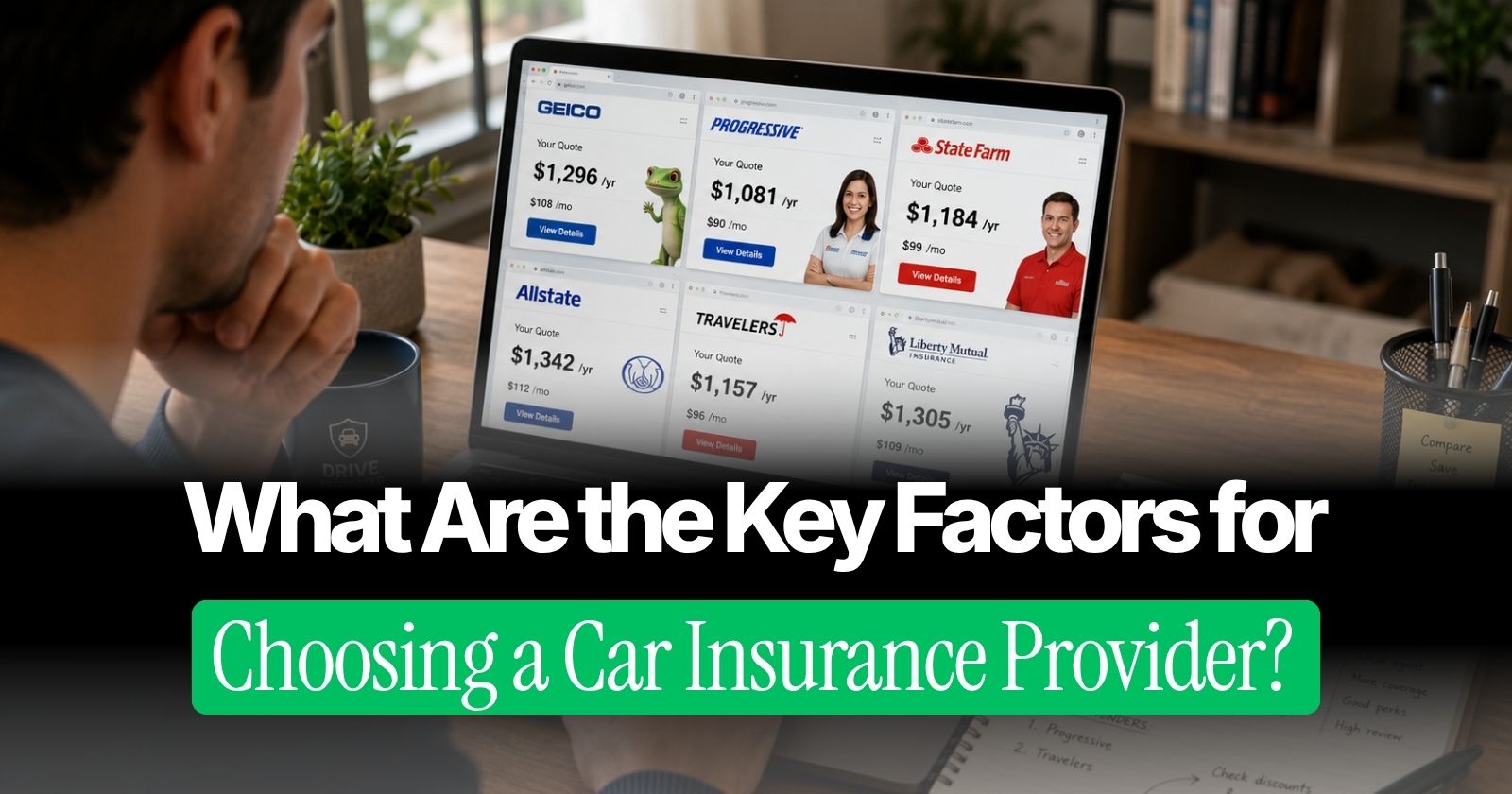

Most drivers pick a car insurance provider the same way they pick a new streaming service: they go with the one they’ve heard of, or the one with the flashiest commercial, or wherever they get the lowest quote on the first site they visit.
That approach works fine until the day you actually have to file a claim — and discover that the insurer you chose is slow, difficult, or disputes your payout.
Choosing the right car insurance provider is not just about finding the cheapest quote. It’s about finding the provider that will be easiest to work with, most reliable in a crisis, financially strong enough to pay out when it counts, and priced competitively for your specific profile.
This guide gives you every key factor in clear terms — including several that most comparison sites skip entirely — and a practical framework for making the final decision.
Disclaimer: This article is for informational and educational purposes only. It does not constitute insurance or financial advice. Coverage, pricing, and ratings vary by state, insurer, and individual profile. Always consult a licensed insurance professional for advice specific to your situation.
1. Why Your Choice of Provider Matters as Much as Your Coverage
Here’s a fact that reframes the entire shopping process:
Although the driving profile is the same, there can be hundreds of dollars in premium difference between the cheapest and most expensive company. This price difference shows why it is so important to compare multiple providers. WebMD
But price is only one dimension. The insurer you choose determines how fast your claim gets paid, whether your repair shop receives direct payment or you have to front the money, whether you have a dedicated agent or spend 40 minutes on hold, and whether a disputed claim gets resolved in your favor or turned into a months-long headache.
The team at Money reviewed 23 auto insurers based on 25+ factors, which they grouped into five broad categories: customer satisfaction, pricing, coverage options, user experience, and financial stability — giving the most weight to customer satisfaction and cost. clinicaltrials
That weighting is instructive. The professionals who analyze insurers for a living consistently rate customer satisfaction above pure price. This guide is built around the same logic.
2. Factor 1: Financial Strength — Will They Actually Pay Your Claim?
This is the foundational question that most drivers never think to ask — but it’s the one that matters most in a worst-case scenario.
It’s important that any insurance company you’re considering can pay out on claims. A.M. Best’s financial strength scores indicate the likelihood that an insurer will be able to make good on its financial obligations. Look for companies that score an A or better. Grow Forage Cook Ferment
AM Best ratings explained:
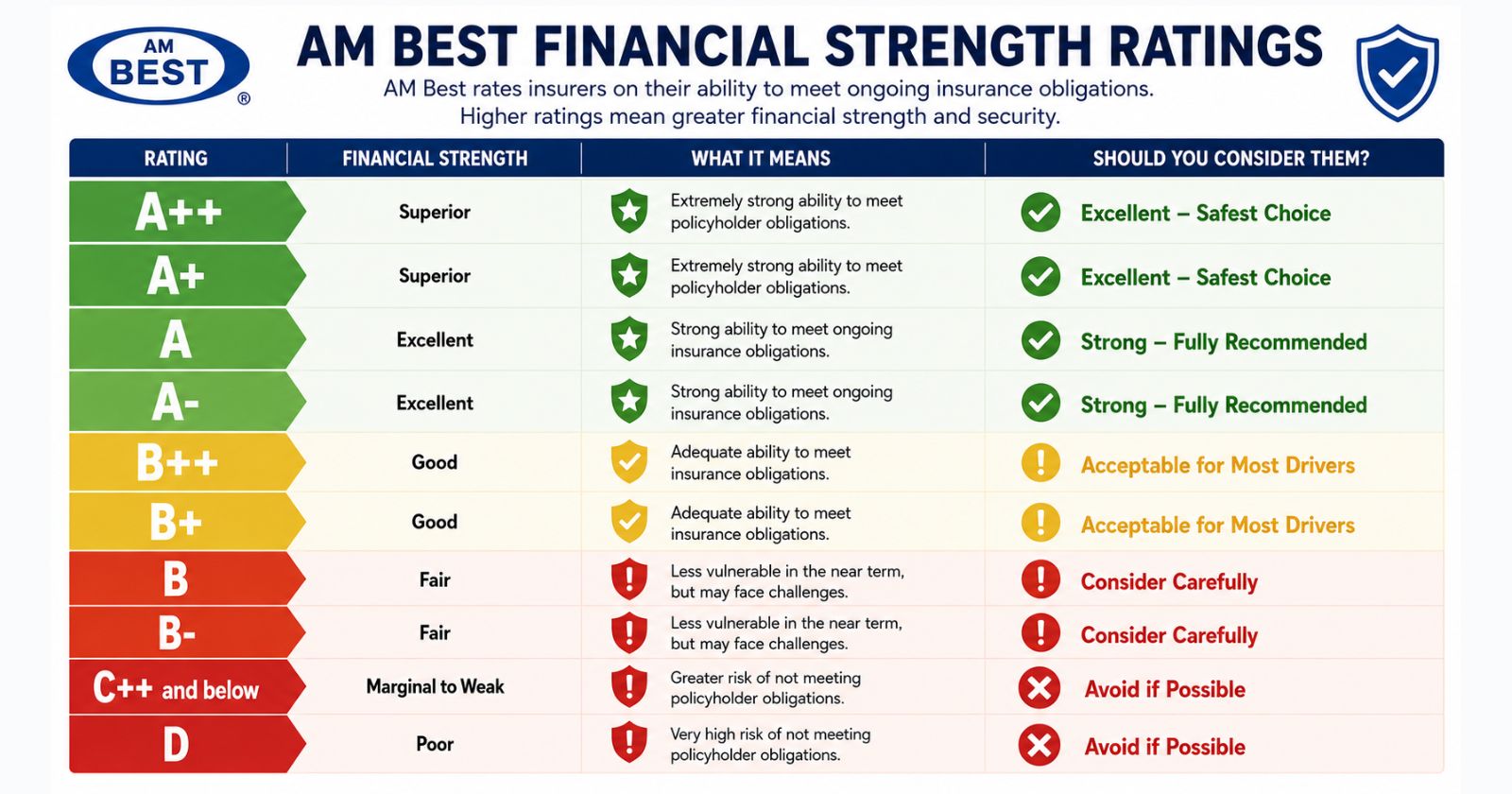
| AM Best Rating | What it means | Should you consider them? |
|---|---|---|
| A++ / A+ | Superior financial strength | ✅ Excellent — safest choice |
| A / A- | Excellent financial strength | ✅ Strong — fully recommended |
| B++ / B+ | Good financial strength | ⚠️ Acceptable for most drivers |
| B / B- | Fair financial strength | ⚠️ Consider carefully |
| C or below | Marginal or weak | ❌ Avoid if possible |
Every major national insurer — State Farm, GEICO, Progressive, Allstate, Travelers — holds an A or better rating. Regional insurers vary more widely, and this is where checking AM Best matters most.
Pro Tip: You can look up any insurer’s AM Best rating for free at ambest.com. This takes about 60 seconds and tells you whether your insurer could realistically pay out a large claim. Never buy a policy from an insurer rated below B+ without a very specific reason.
3. Factor 2: Claims Satisfaction — What Happens When You Actually Need Them?
An insurer’s entire value proposition is realized in one moment: when you file a claim. Everything else — the commercials, the discounts, the mobile app — is secondary to whether the company treats you fairly and efficiently when something goes wrong.
The best third-party source for claims satisfaction in the US is the J.D. Power Auto Claims Satisfaction Study, published annually.
NerdWallet’s editorial team uses J.D. Power’s annual studies as a key data source for consumer experience ratings when evaluating auto insurers — specifically looking at how customers rate the claims process, speed of resolution, and overall satisfaction. GoodRx
Amica earned a spot on the Honor Roll of the 2026 CRASH Network Insurer Report Card, with a B+ grade and a 12th place ranking overall among 91 companies. Amica also ranked above average in J.D. Power’s Claims Satisfaction Study. Cleveland Clinic
What J.D. Power measures in claims satisfaction:
- First notice of loss (how easy is it to report a claim?)
- Service interaction (how helpful and communicative are adjusters?)
- Repair process (how smoothly are vehicle repairs handled?)
- Rental experience (if applicable)
- Settlement (how fairly and quickly is the claim paid?)
Allstate stands out in consumer surveys for the high percentage of customers who express satisfaction with the ease of filing a claim and how their claim was resolved. nih
When comparing two providers with similar prices, J.D. Power claims satisfaction scores should be your tiebreaker.
4. Factor 3: The NAIC Complaint Ratio — The Tool Most Drivers Never Use
This is the factor most comparison guides mention briefly and never explain. It’s actually one of the most powerful tools available to insurance shoppers — and it’s completely free.
What is the NAIC Complaint Ratio?
The National Association of Insurance Commissioners (NAIC) tracks every formal complaint filed against every licensed insurer in the United States. They then calculate a complaint ratio — the number of complaints relative to the company’s market share. A ratio of 1.0 is the national average. Below 1.0 is better than average. Above 1.0 means more complaints than expected for a company that size.
Acuity receives the fewest customer complaints for the amount of coverage it sells compared to other top insurers, according to data from the National Association of Insurance Commissioners (NAIC). GoodRx
How to use the NAIC complaint ratio:
- Visit naic.org/consumer_home.htm
- Search your state or use the national database
- Look up any insurer by name
- Compare the complaint ratio to the national median of 1.0
A company with a ratio of 0.30 has 70% fewer complaints than average for its size. A company with a ratio of 2.5 has 150% more complaints than average. This tells you far more about real-world customer experience than any marketing material.
| Complaint ratio | What it means |
|---|---|
| Under 0.50 | Excellent — far fewer complaints than average |
| 0.50–1.00 | Good — below or at average |
| 1.00–1.50 | Watch out — more complaints than average |
| Over 1.50 | Red flag — significantly more complaints than expected |
Pro Tip: The NAIC tool is free and takes about two minutes to use. Running this check before committing to a provider has saved thousands of drivers from signing with companies that look great in advertising but perform poorly in practice.
5. Factor 4: The CRASH Network Report Card — What Repair Shops Think
This is the factor almost no consumer guide covers — and it’s arguably the most honest signal of how an insurer behaves in the real world.
What is the CRASH Network?
The CRASH Network publishes an annual Insurer Report Card based on surveys completed by thousands of auto body repair shops across the country. Repair shops work directly with insurance adjusters on every single claim — they see, up close, whether insurers approve adequate repairs, pay fair labor rates, allow quality parts, and treat customers honestly.
Their grades reflect what happens behind the scenes on every claim — far more than what any customer satisfaction survey captures.
Amica earned a spot on the Honor Roll of the 2026 CRASH Network Insurer Report Card, with a B+ grade and a 12th place ranking overall among 91 companies. Cleveland Clinic
In the 2026 report, most large national carriers received grades in the C+ to B- range. Smaller regional carriers with strong local reputations — like Erie, Auto-Owners, and Amica — consistently outperformed larger national brands.
NerdWallet’s editorial team also looks at the CRASH Network Insurer Report Card when evaluating auto insurance companies, using it as a signal of how insurers handle the actual mechanics of claim resolution. GoodRx
What grades to look for: Aim for B or better. Any insurer with a D or F grade from repair shops should be treated with serious caution — it suggests systematic problems with how claims are handled at the repair level, which directly affects the quality of your vehicle’s repairs.
6. Factor 5: Price — And How to Compare It Correctly
Price is where most people start — and where most comparison mistakes happen. Here’s how to do it right.
In 2026, the average cost of auto insurance is $2,356 annually for full coverage, or $196 per month. The average cost of minimum coverage is $722 annually, or $60 per month. Cleveland Clinic
But averages mask enormous variation:
Car insurance costs vary greatly based on a wide range of factors. According to Consumer Reports, drivers in Florida shell out nearly $4,000 a year, while drivers in Vermont typically pay less than $1,500. clinicaltrials
The correct way to compare prices:
- Get at least three quotes — it is recommended to compare auto insurance quotes from different companies every six months, as rates fluctuate regularly and the cheapest company for you may change. Cleveland Clinic
- Use identical coverage specs across every quote — same liability limits, same deductibles, same add-ons. Comparing a $500 deductible policy at Company A to a $1,000 deductible policy at Company B tells you nothing useful.
- Include regional carriers — at the state level, regional carriers beat national brands on price and service more than national rankings suggest. Their business is concentrated in a smaller market, so claims and agent networks are built around local conditions. ALM Corp
- Look at the six-month total, not the monthly payment — monthly payment options sometimes include financing fees that inflate the real cost.
- Don’t choose the cheapest option blindly — when choosing a policy, it is important to purchase as much car insurance as you can reasonably afford. Having state minimum levels of liability may not be enough to protect you financially if you are at fault in an accident, which means you could have your assets seized or wages garnished. MasterClass
What the research shows on “cheapest” insurers:
Among major national providers, USAA, GEICO, and Travelers tend to offer the best rates. Regional providers Erie, Auto-Owners, and Plymouth Rock also have cheap rates. However, the cheapest company varies widely by driver profile, location, and coverage level. An Off Grid Life
7. Factor 6: Coverage Options and Add-Ons
Not every insurer offers the same menu of coverage options. Depending on your situation, certain add-ons could be the difference between a manageable and a catastrophic financial event.
Standard coverage every provider should offer:
- Liability (bodily injury and property damage)
- Collision
- Comprehensive
- Uninsured/underinsured motorist
- Personal injury protection (PIP) or medical payments (MedPay)
Add-ons worth checking for specifically:
| Add-on | Why it matters | Who should prioritize it |
|---|---|---|
| New car replacement | Pays for a brand-new car, not depreciated value, if yours is totaled | Owners of new vehicles in first 1–2 years |
| Accident forgiveness | Your first at-fault accident doesn’t raise your rate | Clean-record drivers who want price stability |
| Rideshare coverage | Covers the gap between your personal policy and what Uber/Lyft provides | Drivers who work for Uber, Lyft, or DoorDash |
| Gap insurance | Pays the difference between your loan balance and your car’s ACV if totaled | Anyone with an auto loan on a newer car |
| Roadside assistance | Towing, flat tire, jump-start, lockout | Drivers without AAA or a card benefit that covers this |
| Auto glass waiver | Covers windshield repair with no deductible | Drivers in hail-prone states or high-debris areas |
| Rental reimbursement | Covers a rental car while yours is being repaired | Anyone who’d be stranded without their vehicle |
Progressive offers some of the best coverage add-ons among top picks, with options like vet reimbursement and minor dent repair coverage. Amica offers auto glass coverage that eliminates your deductible on windshield and window repairs — only two national carriers offer it, and anyone who’s paid $400 out of pocket for a windshield replacement knows why it matters. GoodRxALM Corp
Check which of these you actually need before choosing a provider. If you’re a rideshare driver, for example, a provider that doesn’t offer rideshare coverage is a non-starter regardless of price.
8. Factor 7: Discounts — And Whether They Actually Apply to You
Every insurer advertises discounts. Most drivers claim only a fraction of what they’re entitled to — because nobody ever walks them through the full list.
The key insight: Don’t compare the quantity of discounts — compare which specific discounts you qualify for. An insurer with 12 discounts that don’t apply to you is worse than one with 6 that all do.
Common discounts and who actually benefits:
| Discount | Who qualifies | Typical savings |
|---|---|---|
| Bundling (home + auto) | Homeowners with both policies | 15–25% |
| Multi-vehicle | Households with 2+ cars | 10–20% |
| Good driver / safe driving | No accidents or violations for 3–5 years | 10–30% |
| Good student | Students with B average or higher | 10–25% |
| Defensive driving course | Drivers who complete an approved course | 5–10% |
| Low mileage / pay-per-mile | Drivers under ~7,500 miles/year | Up to 30% |
| Military / affinity group | Active duty, veterans, alumni groups | 5–15% |
| Autopay / paperless | Anyone willing to set it up | 3–5% |
| Anti-theft device | Vehicles with tracking or alarm systems | 5–15% |
GEICO’s discount offerings are a main reason it was named Best Budget-Friendly Auto Insurance in NerdWallet’s 2026 Best-Of Awards. GEICO is also one of the best insurance companies for financial strength, customer experience, and digital offerings. GoodRx
Before getting a final quote from any provider, ask your agent or the online quote tool to apply every discount that could apply to your profile. This step alone can reduce your quoted premium by 15–30%.
9. Factor 8: Digital Experience and App Quality
In 2026, the quality of an insurer’s mobile app and website is no longer a nice-to-have — it directly affects how easy it is to file a claim, get proof of insurance, manage your policy, and reach support.
What to evaluate:
- App store ratings — Check both Apple App Store and Google Play ratings. Apps consistently below 4.0 stars suggest a poor user experience that will frustrate you the moment you need to file a claim at the roadside.
- Online claims filing — Can you file a claim entirely through the app without calling anyone? The best modern insurers make this possible in under 10 minutes.
- Digital ID cards — Accepted in all 50 states, digital insurance cards are standard now. Any insurer not offering them is behind.
- Policy management — Can you update your address, add a vehicle, or change a deductible online without calling? This matters at renewal.
GEICO’s mobile app has high ratings for both Android and Apple devices. Additionally, GEICO’s website provides helpful information about car insurance, and you can start and manage your policy online. GoodRx
Amica ranked in the top two in J.D. Power’s Digital Experience Study for both the service and shopping categories, making it a great option for those looking to manage their policy digitally. Cleveland Clinic
Pro Tip: Before committing to a provider, download their app and spend five minutes navigating it. An app that’s confusing when you’re calm will be genuinely stressful at the side of a damaged car. This test takes minutes and reveals a lot.
10. Factor 9: Local Agent vs. Online-Only — Which Model Fits You
Insurance companies operate through two different models, and your preference should influence which providers you consider.
Agent-based model (State Farm, Allstate, Farmers):
- You have a named local agent who knows your policy
- Easier to get personalized advice on coverage decisions
- Claims often handled with more personal follow-through
- Can be more expensive because of the agent infrastructure
Online/direct model (GEICO, Progressive online, Lemonade):
- All interaction through website, app, or call center
- Usually faster to get quotes and change policies
- Often cheaper due to lower overhead
- Works best for straightforward policies with no complex coverage needs
Unlike State Farm, which has a wide agent network, GEICO conducts most of its business online. If budget is top of mind, GEICO is a good bet for most drivers — including certain high-risk drivers like those with poor credit. Cleveland Clinic
Which model is right for you?
Choose agent-based if: You have a complex situation (multiple vehicles, young drivers, business use, unusual coverage needs), you value relationship-based service, or you’re uncomfortable navigating insurance decisions alone.
Choose online-direct if: Your situation is straightforward, you’re comfortable researching coverage options yourself, price is your primary concern, and you prefer managing everything through an app.
11. Factor 10: Regional vs. National Insurers — The Decision Most Guides Skip
Most comparison articles focus entirely on the national brands. This is a significant omission — regional insurers consistently outperform national brands in specific states on both price and service.
Regional carriers often beat national brands. Auto-Owners is a telling example — it ranks best in multiple states where it operates, consistently outperforming national competitors on both price and claims satisfaction in those markets. ALM Corp
Regional insurers worth considering by region:
| Region | Strong regional options |
|---|---|
| Northeast | Erie Insurance, Amica |
| Midwest | Auto-Owners, Westfield |
| Southeast | Southern Farm Bureau, ALFA |
| West/Southwest | CSAA, Mercury Insurance |
| Military families (nationwide) | USAA |
USAA offers financial services like insurance, banking, and investment advice for members and veterans of the US military, pre-commissioned officers, and their spouses and children. If you qualify, USAA is a great choice — offering the cheapest car insurance rates of top picks along with exceptional customer service. Cleveland Clinic
The trade-off: regional insurers may not be available in every state, may have fewer digital tools, and may have smaller agent networks. But if they operate in your state, they’re absolutely worth including in your quote comparison.
12. The Decision Framework: How to Weigh It All
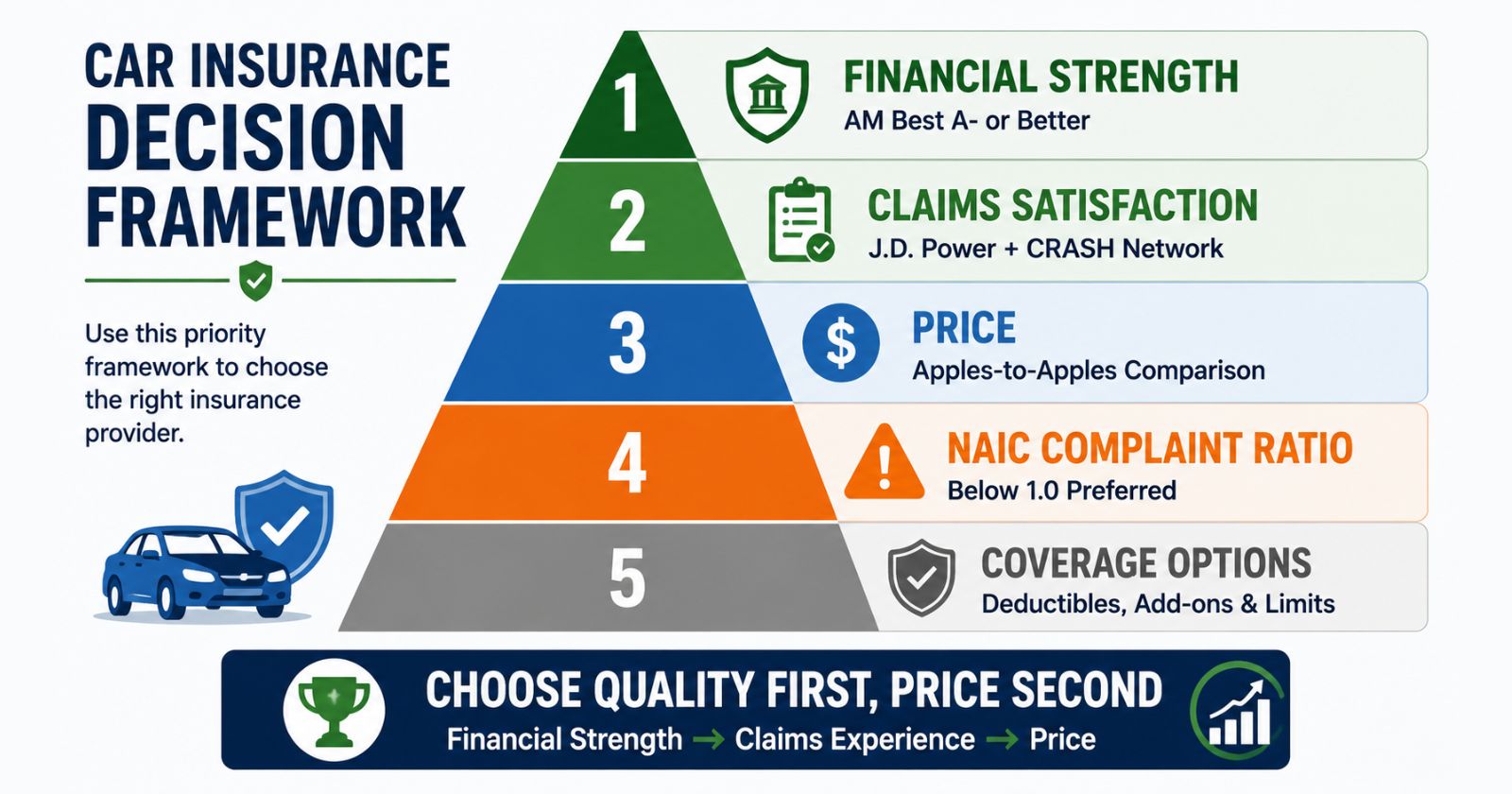
With ten factors to evaluate, the final decision can feel overwhelming. Here’s a weighted framework that puts them in order of importance for most drivers:
| Priority | Factor | Weight | Why it matters this much |
|---|---|---|---|
| 1st | Financial strength (AM Best A or better) | Essential | A cheap policy from an insurer that can’t pay is worthless |
| 2nd | Claims satisfaction (J.D. Power + CRASH Network) | Very high | This is the only moment the policy actually delivers value |
| 3rd | Price (apples-to-apples comparison) | High | Hundreds of dollars difference annually for identical coverage |
| 4th | NAIC complaint ratio (below 1.0) | High | Reveals real-world customer experience without marketing bias |
| 5th | Coverage options and relevant add-ons | High | Non-negotiable for specific situations (rideshare, new car, etc.) |
| 6th | Discounts that apply to your profile | Medium | Can significantly narrow price gap between providers |
| 7th | Digital experience and app quality | Medium | Determines day-to-day friction and claims-filing ease |
| 8th | Agent vs. online model | Medium | Personal preference, but affects service quality for complex cases |
| 9th | Regional vs. national | Medium | Regional carriers can offer superior value in specific states |
| 10th | Brand recognition | Low | Familiarity with commercials is not a measure of quality |
The three-step final decision process:
Step 1: Eliminate any insurer rated below A- by AM Best, or with an NAIC complaint ratio above 1.5. These are objective disqualifiers.
Step 2: Get three or more apples-to-apples quotes from the remaining candidates. Include at least one regional carrier if available in your state.
Step 3: Among providers within $200/year of each other, choose the one with the best J.D. Power claims satisfaction score and lowest NAIC complaint ratio. Price similarity narrows to a service quality decision.
For more car insurance guides, check out our breakdown of what comprehensive car insurance covers and the 11 real reasons your car insurance is so high — and explore InfoBrave for more practical everyday guides on finance, insurance, and lifestyle.
13. Frequently Asked Questions
What is the most important factor when choosing a car insurance company?
Financial strength is the foundational requirement — an insurer with an AM Best rating below A- may not be able to pay a large claim. After that, claims satisfaction is the most important practical factor: the insurance company’s only real job is to pay claims fairly and quickly when you need them to. Price matters, but only after financial strength and claims quality are confirmed.
How do I compare car insurance companies fairly?
To compare car insurance companies, first determine how much coverage you need, then get quotes from at least three providers using identical coverage levels so you’re making an apples-to-apples comparison. You can work with a local broker, fill out quote forms directly with insurers online, or use an aggregator. Always include at least one regional carrier in your comparison. An Off Grid Life
What is the AM Best rating and why does it matter?
AM Best is an independent financial rating agency that evaluates the financial strength of insurance companies. A.M. Best’s financial strength scores indicate the likelihood that an insurer will be able to make good on its financial obligations. Look for companies that score an A or better. A low AM Best rating means the company might struggle to pay large claims — making financial strength the first filter to apply when evaluating any insurer. Grow Forage Cook Ferment
What is the NAIC complaint ratio?
The NAIC complaint ratio measures how many formal consumer complaints an insurer receives relative to its market share. A ratio of 1.0 is the national average. Acuity receives the fewest customer complaints for the amount of coverage it sells compared to other top insurers, according to NAIC data. You can look up any insurer’s ratio free at naic.org — ratios below 0.5 indicate excellent customer service; ratios above 1.5 are a red flag. GoodRx
Is a regional insurance company better than a national one?
Sometimes, yes. Regional carriers often beat national brands on both price and service at the state level. Their business is concentrated in a smaller market, so claims and agent networks are built around local conditions rather than national averages. Always include at least one strong regional carrier (Erie, Auto-Owners, Amica) alongside national quotes to make a fair comparison. ALM Corp
How often should I shop for new car insurance quotes?
It is recommended to compare auto insurance quotes from different companies every six months, as rates fluctuate regularly and the cheapest company for you may change. At minimum, shop at every annual renewal. Your profile changes over time — accidents age off, credit scores improve, vehicles depreciate — and the market moves too. Staying with the same insurer for years without checking competitors often costs hundreds of dollars annually. WebMD
What coverage level should I choose?
It is important to purchase as much car insurance as you can reasonably afford. Having state minimum levels of liability may not be enough to protect you financially if you are at fault in an accident — you could have assets seized or wages garnished to pay for accident-related expenses that go beyond your liability limits. The recommended minimum is 100/300/100 liability coverage. MasterClass
Does the insurance company’s size matter?
Bigger is not automatically better. Larger companies have higher name recognition but don’t consistently outperform smaller regional insurers on claims handling or customer satisfaction. What matters is AM Best rating, NAIC complaint ratio, and J.D. Power claims scores — not the size of the company’s advertising budget.
You may also like: Dollar-Cost Averaging Explained: The Beginner Strategy That Removes All the Guesswork (2026)